

The Chocolate Spoon My Retired Neighbor Stirs Into Her Coffee. I Read the Pouch.
Earth Echo's Cacao Bliss is a powder, not a capsule — raw Peruvian cacao, turmeric, MCT and black pepper in a resealable pouch. Eight grams a scoop, 35 calories, under 1 gram of sugar. I read the label first.

First, the people: Margaret Ellery is a pen name, and Ruth from this story is a composite of two retired schoolteachers and one book-club host, the way magazine columns have always worked.
Everything here about the powder comes from the seller's own listing, its printed label, and its published reviews, all read in October 2026.
The Focused Reader doesn't sell supplements. We read pouches out loud at the kitchen table, print what we find, and let you make up your own mind.
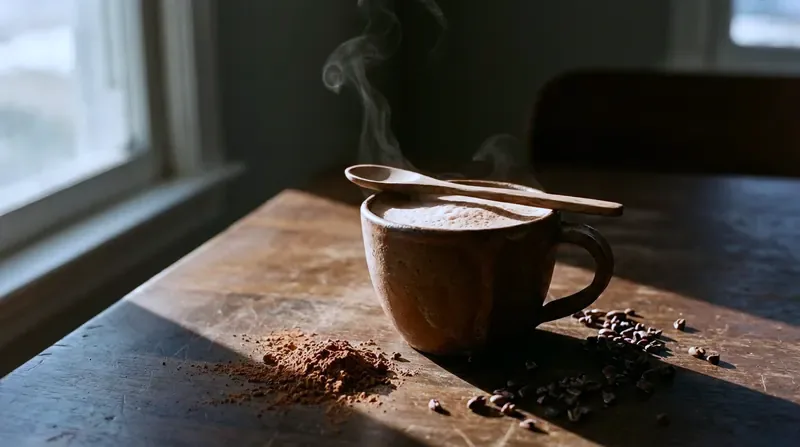
Ruth Harmon taught fourth grade for thirty-one years, and her kitchen table has two drawers: one for the good scissors and one for the reading glasses that never seem to be where she left them.
At sixty-eight, she has exactly one rule about mornings: the coffee happens before anything else does.
Which is why, last February, her sister-in-law's gift caused such a fuss at the book club. Not a mug warmer.
Not a tin of shortbread. A glossy blue pouch with gold lettering: Cacao Bliss.
"You stir a scoop of it into your coffee," Ruth explained, holding it up to the window light like a rare manuscript. "It turns your coffee into chocolate.
That's the whole idea."
The book club, being a book club, had questions. Is it candy?
Is it one of those vitamin things? Does it taste like the cocoa we drank in 1974, or like the fancy stuff my daughter buys?
Ruth didn't know yet. She'd received the gift two days earlier and, being a teacher to the bone, had not opened it.
"I read things twice before I trust them," she said. "Once fast, once slow.
The pouch was still on its first read."
This column is what happened on the second read: the label, the company, the reviews, the price, and the Tuesday morning the book club finally got to taste the thing.
The Pouch, Examined Like a Term Paper
Ruth taught fourth graders, but her grading rubric works on anything: neatness, honesty, and whether every claim can be checked.
The pouch earns its marks on neatness immediately. It's a resealable stand-up bag, 8.34 ounces, with a tear notch and a zipper.
No box, no plastic seal to fight with, no cotton wad hiding the top of the container.
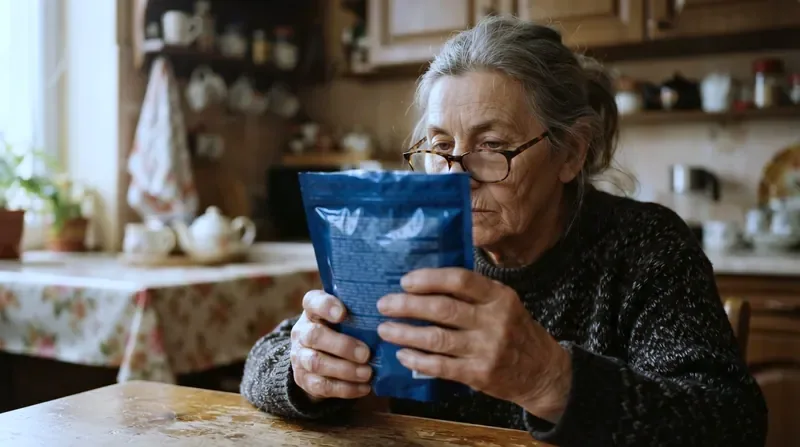
The front panel says Cacao Bliss in large gold letters, under the words Earth Echo and above a picture of a blue bowl heaped with raw cacao and a wooden spoon. The company calls the cacao "ceremonial grade," which we'll get to, because that phrase is doing a lot of work.
Along the bottom edge, five small round badges: gluten free, non dairy, USDA organic, soy free, non GMO. Four of the five are claims about what isn't in the pouch, which Ruth calls "the easy promises."
The fifth — USDA organic — is a certification somebody else co-signs. That one carries weight in her rubric.
The back panel is where the term paper gets interesting, and where this column now goes, line by line.

The Label, Read Out Loud
Every honest label column starts the same way: serving size, first, because everything else on the panel hangs from it.
The serving is 2.5 teaspoons of powder, which the label calls 8 grams. There are 30 servings in the pouch.
One scoop, once a day, and the pouch lasts a month.
What those 8 grams contain, in the plainest arithmetic on the panel: 35 calories. 1.5 grams of fat, all of it saturated, because coconut is in the blend. 3 grams of carbohydrate, of which 2 grams are fiber.
And the line Ruth read twice, once fast and once slow: total sugars, less than 1 gram. Added sugars, less than 1 gram, 2 percent of a day's allowance.
Less than a gram of added sugar in something that calls itself chocolate. That number will matter later, when we get to the sweeteners.
Below the nutrition lines sits the phrase every supplement shopper learns to find: proprietary blend, 7.88 grams. Eleven ingredients follow it, in order, without a single milligram printed for any of them.
The order matters more than most people know. By weight, whatever is listed first is the biggest part of the blend, and each line after it's smaller.
The first line is organic cacao bean powder. The powder is mostly cacao, by law of arithmetic if nothing else.
After the cacao: organic MCT oil powder, organic coconut flower nectar powder, organic cocoa bean powder, organic turmeric root powder, Himalayan sea salt, organic cinnamon bark powder, organic monk fruit extract, organic lucuma fruit powder, organic mesquite pods powder, and — last, the smallest pinch — organic black pepper fruit powder.
Eleven lines, one number. Ruth's margin note, in pencil: "the label tells you the choir but not how loud anyone sings."
The panel closes with the sentence the government makes every supplement print: the statements on the pouch haven't been evaluated by the Food and Drug Administration, and the pouch isn't meant for any medical use whatsoever.
The column prints it too, because it outranks everything else on the pouch.
What "Ceremonial Grade" Actually Means
The phrase appears three times on the listing, always in quotation marks that belong to the seller, not to any regulator.
"Pure" means just the cacao seed, fermented and dried, ground without the high heat that turns cacao into the cocoa powder of a supermarket baking aisle. Nothing added, nothing alkalized.
"Ceremonial grade" isn't a government grade. There's no USDA definition, no laboratory threshold, no certificate.
It's the cacao trade's own term for the highest-quality drinking cacao, the kind traditionally prepared as a bitter beverage, and it's sourced, the listing says, from a single farm in Peru.
A single farm is checkable in principle, and Ruth checked as far as a shopper can: the listing repeats it, the brand's story repeats it, and nothing contradicts it. "Sourced for you," says the script signature near the bottom of the pouch, and that's a motto, not a citation.
What the phrase honestly translates to, in the Focused Reader's dictionary: this is the good cacao, the minimally processed kind, from one named origin. It isn't a promise of anything beyond that, and the seller's own asterisks agree.
Because the front of the pouch also says, in small capitals, "supports mental focus, boosts your energy, and reduces cravings," each word followed by that asterisk.
The asterisk walks the sentence back to the FDA disclaimer. The pouch promises structure and function, the way all American supplements do, and nothing more.
This column takes the same position the asterisk takes, and we won't be repeating those three verbs as if they were findings.
Ruth's ruling on the phrase: "It's a compliment to the bean, not a claim about your brain. The pouch seems to know the difference.
So should we."
The Company Behind the Pouch
A teacher doesn't trust a handout she can't trace to a publisher, and Ruth doesn't trust a pouch she can't trace to a company.
The trace runs to Boulder, Colorado. Earth Echo Foods, LLC, 1630 30th Street, Suite A-407, is the seller of record.
There's a phone number printed on the listing — 888-997-3851, answered 9 to 9 Eastern — and an email that begins with "support."
The company was founded by Danette May, a wellness coach whose own story — a hard stretch, a kitchen, a blender, a decision to eat like she meant it — is told on the company's own pages without embarrassment.
Ruth read the founder's story the way she used to read parent notes: for what it claims and for what it doesn't. "It's a biography," she ruled.
"Not a study. But it's a real biography with a real name, and that's more than half the internet can say."
The returns policy is printed on the same site: 60 days, refunds for orders within 60 days of purchase, questions to the support email. Returns ship to a warehouse in Robbinsville, New Jersey.
No mystery there either. A street address, a phone, a named founder, a return address.
Ruth's rubric gives the company full marks on honesty of contact, which is rarer than it should be in the vitamin aisle.
And shipping, the line every shopper checks last: the store's standing notice says free shipping on orders over $100, and the single-pouch listing adds a "free shipping" flag of its own. At $69.95, the pouch alone rides under the $100 line — but the listing was showing its own flag when we read it, and we print what we read, with the date.
The Aroma Test, and the First Scoop
The book club convened on a Tuesday in late February, four women, one kitchen, one pouch, and a kettle.
Ruth opened the zipper seal with a teacher's care — "you don't tear the term paper" — and the first thing everyone noticed was the smell.
Dolores, 71, the club's designated skeptic, put her nose over the bag and paused. "That smells like the chocolate shop on Fifth Street.
The expensive one where they never have a sale."
The powder itself is dark brown, fine, slightly clumped the way unprocessed powders are, and it smells of chocolate first, then something warm underneath it that Dolores eventually identified as cinnamon.
The first scoop went into Ruth's coffee. The stirring took about fifteen seconds.
What came up out of the mug was darker than the original coffee, with a fine foam on top from the whisking, and it smelled, in Dolores's official opinion, "like dessert pretending to be breakfast."
The verdicts, in seating order, because that's how the club does everything:
Ruth, 68, host: "Rich.
Not sweet.
It's chocolate for grown-ups. I've had cocoa that tasted like a candy bar dissolved in milk — this isn't that."
Dolores, 71, skeptic: "Surprised.
I expected vitamin flavor.
I got... a very serious cup of chocolate. I'm suspicious of how much I like it."
Patsy, 65, sweet tooth: "It's not sweet enough for me plain, but in coffee it's right.
My coffee has always been too bitter for the last cup anyway."
June, 69, this columnist, undercover: "The foam is the giveaway.
Cheap powders don't foam.
This whisked up like something from a café."
Four cups, four opinions, one theme: dark chocolate flavor, very little sweetness, something warm under it.
The seller's own mixing directions, printed right on the listing, had told us as much: "Mix a scoop into almond milk, Regular milk, or even water! Stir or shake until creamy, frothy and smooth."
Patsy tried it in hot water the following week and reported back by phone: "Drinkable. Barely.
In water it tastes like what it's — dark chocolate with no sugar. It needs the milk or the coffee."
The club's summary, filed by Ruth on an index card: "The pouch makes good chocolate. It doesn't make sweet chocolate.
Both of those are true, and the second one is why the sugar line on the label is under a gram."

The Sweetener Question
How do you make a chocolate powder with less than one gram of added sugar taste like anything? The label answers in three ingredients, and the answer is more interesting than a cheat.
Coconut flower nectar powder comes third in the blend.
Coconut nectar is the sap of the coconut blossom, dried and ground; it carries a caramel note and, being third of eleven lines, there isn't much of it in a scoop.
Monk fruit extract sits eighth.
Monk fruit is a small melon from southern China whose extract is wildly sweeter than sugar, spoon for spoon.
A trace of it does the work of a teaspoon of the white stuff, without adding calories worth counting.
And the sugar line — less than 1 gram — now reads like arithmetic instead of a claim. A whisper of coconut nectar for roundness, a trace of monk fruit for sweetness, and the total lands under a gram.
Patsy, the sweet tooth, took the news personally. "So it's honest chocolate.
That's what I'm tasting. Chocolate with a small scholarship."
There are two more flavor lines on the label that neither of us had ever seen on a vitamin shelf: lucuma and mesquite.
Lucuma is a Peruvian fruit, dried and powdered, that tastes faintly of maple and sweet potato. Mesquite is the pod of a desert tree, ground into a flour with a nutty, brown-sugar note.
Both are old foods doing new work as gentle flavoring.
The seller's listing describes lucuma as adding "a hint of caramel-like flavor" and mesquite as "a sweet and nutty superfood." Both sentences are the seller's, asterisk attached, and both happen to match what a spoon of the powder actually tastes like.
Ruth's margin note on the sweetener section: "The sweetening is done with food, not with chemistry homework." For a woman who distrusts ingredient lists longer than her attendance sheet, that's close to a standing ovation.
The Turmeric, and the Pepper Beside It
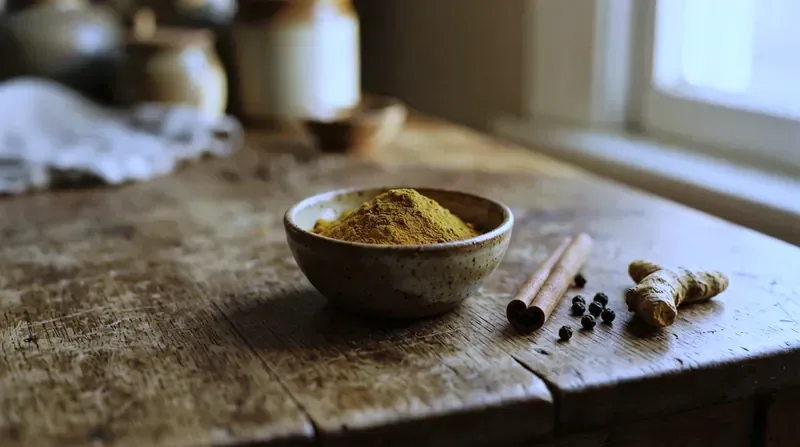
Halfway down the blend sits a line that made Ruth stop reading and put the kettle back on: organic turmeric root powder, fifth of eleven, no milligrams printed.
Turmeric is the golden root that colors curry, and it's the reason this pouch smells faintly of something warmer than chocolate. The listing gives it a sentence of its own: "Fights temporary inflammation related to physical exercise," asterisk, FDA disclaimer.
That sentence belongs to the seller, and the asterisk is doing exactly what asterisks do. This column's job is to say what the research file actually holds, so here it is.
The research file holds a trial of a concentrated curcumin preparation — not kitchen turmeric — in adults over 50, at 90 milligrams twice a day, for 18 months, with better memory scores in the group that took it.[1]
And it holds the government's own summary: we don't know enough to conclude whether turmeric is beneficial for any health purpose, and there are cautions about highly concentrated formulations.[2]
Kitchen turmeric in a blend, without a printed milligram figure, can't be set against either of those sentences. The label doesn't pretend otherwise, which is why the milligram column is empty and the asterisk is right there.
Now the black pepper, which is where the seller makes the loudest claim on the whole listing: the pepper is there, the listing says, to increase the "bioavailability" of the turmeric "by up to 2,000 percent." Asterisk.
There's a real thread under that number. Piperine, the compound that gives pepper its bite, is known to slow the breakdown of some other compounds in the body, which is why supplement makers pair the two spices.
But "2,000 percent" is the seller's own figure for its own pairing, printed with an asterisk, and no trial has tested this pouch, this blend, or this dose. The Focused Reader prints the number as the seller's claim and nothing more, the same way we print a motto.
Ruth heard the figure read aloud and gave the column's favorite kind of answer: "Two thousand percent of almost nothing is still almost nothing. If the turmeric is a pinch, the pepper is helping a pinch.
That's not a scandal. It's just arithmetic."
The Cinnamon, and the Salt Nobody Mentions
Two lines of the blend never make it into the marketing copy, and both deserve their paragraph.
Cinnamon bark powder, seventh of eleven. The listing's sentence: "Improves your body's ability to digest glucose," asterisk.
The honest file behind that sentence is thin — the government's own summary says research doesn't clearly support using cinnamon for any health condition — and there are two kinds of cinnamon in the world, one of which carries more coumarin than the other. The pouch doesn't say which kind it uses.
In a blend without printed milligrams, at culinary size, this is a spice acting as a spice. Warmth in the cup, nothing to bank on, nothing to fear for most people.
Anyone who takes anything daily should still run the whole pouch past their own clinician — that sentence runs in every column we print, on purpose.
Himalayan sea salt, sixth of eleven, and the only line in the blend that isn't organic, because salt is a mineral and minerals don't farm. The listing credits it with "over 84 minerals and trace elements" and a hand in "balancing your pH levels," asterisks attached.
The sodium panel is more useful than the poetry: 95 milligrams per serving, 4 percent of a day's allowance. That's less sodium than a slice of bread.
The salt is there, as any pastry chef could have guessed, to make the chocolate taste more like itself.
Ruth read the pH sentence aloud at the club and the club laughed, kindly. "Eighty-four minerals," Dolores said, "and it still mostly tastes like salt."
The MCT Line, Explained Without a Headline
The second-biggest ingredient in the pouch, after the cacao itself, is a fat: organic MCT oil powder.
MCT stands for medium-chain triglycerides, a class of fat molecules shorter than the ones in olive oil or butter. The body takes them up quickly, which is why they turn up in sports drinks, keto coffee creamers, and infant formula, of all places.
The listing gives MCT its own sentence — "to help you feel satiated longer" — asterisk attached, in the seller's usual voice.
What can honestly be said about MCT powder in a chocolate blend, from the plainest reading of the label: it's a food fat, from coconut, that makes the drink rounder on the tongue than cacao alone would be. The 1.5 grams of saturated fat in the panel is mostly this line doing its job.
The creaminess the club kept noticing — the "café foam," the body Dolores called "serious chocolate" — isn't an accident of the cacao. It's the MCT line, behaving exactly the way fats behave in hot liquid.
Ruth's summary for the file: "The fat is the texture. The texture is the reason it feels like dessert instead of homework.
If someone promises you more than that from the fat, ask for their asterisk."
The column will take her ruling one step further, gently: no powder, pouch, or potion on any shelf has ever been shown to give anyone back a memory, and this pouch doesn't claim to. It claims to taste like chocolate and mix into coffee, and it does both.
What the Cacao File Actually Says
Because this is a supplement column and not a dessert review, the honest question deserves its own section: what does research say about cacao and the brain?
The Focused Reader keeps a reference file, and we went to it before the book club's second meeting. Here's the whole honest answer.
Cacao beans are rich in compounds called flavanols, and cocoa flavanols have a genuine research literature behind them — studies of gram-scale cocoa drinks, the kind researchers mix in laboratories, measuring blood flow and thinking tasks.
That literature is interesting, and it isn't about this pouch. The trials used cocoa-drink preparations at doses and concentrations of their own design, standardized and measured to the milligram.
This pouch prints no flavanol figure at all. The blend is 7.88 grams across eleven ingredients, the cacao is the biggest share of it, and "biggest share of a blend with no printed numbers" can't be set against a laboratory's gram-scale drink.
The comparison isn't close; it isn't even possible from the label.
The file also holds the cautionary tale every supplement shopper should know, and it's about a plant with a much longer reputation than cacao: ginkgo.
Ginkgo was the memory herb of the twentieth century, sold on decades of tradition and piles of small studies. Then the largest trial ever run — 3,069 adults aged 72 to 96, a standardized extract at 120 milligrams twice a day, for a median of six years — found no difference from placebo on any measure of memory, attention, language or thinking.[3]
The government's own summary of ginkgo today: no conclusive evidence it helps any health condition.[4]
The lesson isn't that plants are useless. The lesson is that tradition and big promises aren't evidence, and that the only honest sentence about this pouch and anyone's brain is the one the pouch itself prints with its asterisk.
Ruth, who watched the ginkgo years happen from her kitchen table, put it this way: "I outlived the ginkgo aisle. I can outlive a headline.
The chocolate is good; the chocolate isn't a career."
And because the file should always be open when we quote it: none of the research above tested this product, and the column prints that sentence in every study section it will ever run.
The Reviews, Read Like a Class Roster
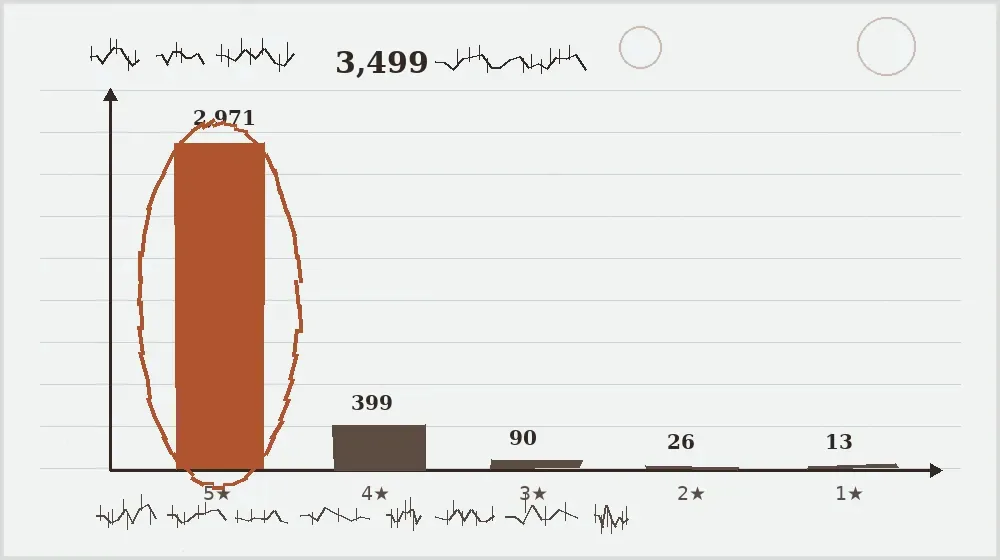
The listing carries its reviews through Okendo, a review platform, and the number at the top is the biggest one on the whole page: 3,499 reviews, averaging 4.8 stars, with 94 percent of reviewers saying they would recommend it.
A number that size deserves the same reading as everything else, so here's what the platform itself reports: 2,971 of the 3,499 reviews are five stars, 50 carry photographs, and the rest spread down the scale.
The Focused Reader read hundreds of them. The five-star shelf, first, in the reviewers' own words:
Deanna, five stars: "Makes my coffee taste better!" The shortest review on the wall, and the one most repeated in different words: this powder lives in the coffee.
Candace, five stars: "Great !" One word, one exclamation point, one satisfied customer who bought a pouch with a bonus pouch attached.
E., five stars: "This cacao has a delicious, rich flavor, and is not too sweet." The most precise review on the wall, and the one that matches the book club's tasting notes exactly.
Jennifer, five stars: "Absolutely delicious, and healthy!
I couldn't be more pleased :)))" Three smiley faces, printed as written.
Amanda, five stars: "I love the cacao superfood blend!" A review of the blend rather than the flavor, which is its own kind of verdict.
That's the five-star shelf, verbatim, and the pattern in it's honest: people like the taste, they stir it into coffee and smoothies, and they keep ordering it.
Now the shelf that keeps the wall honest, because a review wall with no bad days is a billboard, and this one has bad days.
Gretchen, three stars: "I'm mostly just didn't care for the taste.
It was gonna need to have other things added to it for flavor.
The reason I tried it's because of the ingredients in it, but the taste didn't work for me."
Gretchen's review matters because it's the mirror of E.'s five-star "not too sweet." The same dark, low-sugar pour that one reviewer calls rich, another calls needing help. Both are describing the same powder accurately.
Below three stars, the one-star and two-star reviews cluster around taste — "bitter," "not like chocolate," "doesn't dissolve really well" — and around price, which is the next section of this column, because the price deserves its own arithmetic.
Ruth's roster summary: "Strong class. A few transfers.
No scandal — the unhappy reviews are about flavor and money, not about feeling wrong. File under: honest wall."
The Price, Reckoned at the Kitchen Table
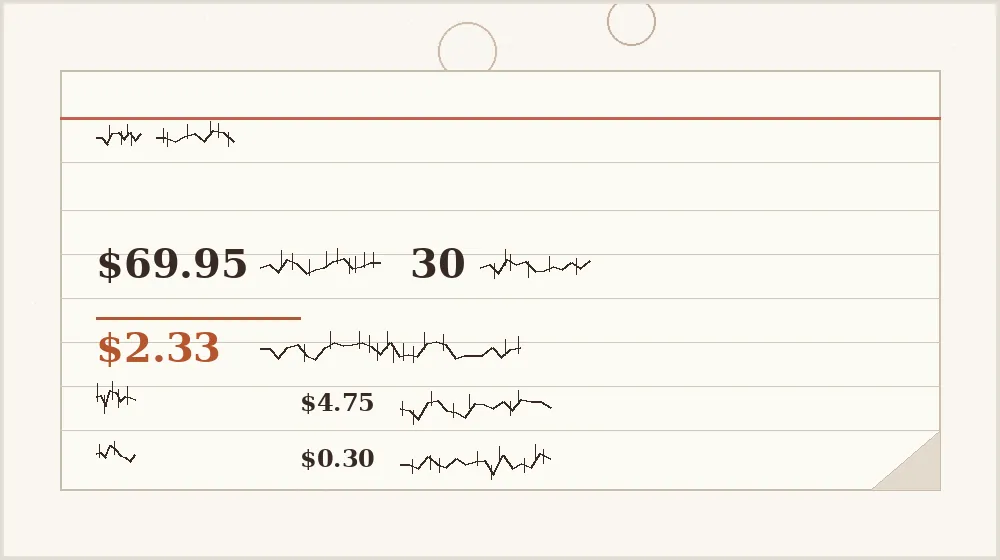
The single pouch — 30 servings, one month of morning scoops — lists at $69.95 on the day we read it, with a "regular price" of $79.99 crossed out above it.
Two prices on one page is a marketing custom, and the honest column quotes the lower one, notes the higher one, and moves on to the arithmetic that matters: cost per morning.
Sixty-nine ninety-five, divided by thirty mornings, is $2.33 a serving. The crossed-out price would have been $2.66.
For context, the comparison shelf at the table:
A small hot chocolate at the café on Fifth Street: $4.75, and the cup is gone in ten minutes.
The coffee it rides in, made at home: about 30 cents, and the coffee was never optional.
So a morning of chocolate coffee at Ruth's table costs about $2.63 all in, of which $2.33 is the scoop and the rest is the coffee it landed in. Whether that's expensive is a household decision, and the column makes it easier, not harder: the pouch also comes in 3-pouch and 6-pouch bundles at lower cost per serving — $1.89 and $1.67 — for anyone past the trial stage.
Dolores, the skeptic, did her own division before anyone asked. "Two-thirty-three for something I'd drink anyway," she said, "or five dollars at the café for less chocolate and no turmeric.
I don't love the price. I hate the café less."
And the 60-day guarantee belongs in this arithmetic, because it changes what a trial costs: sixty days to decide, refunds for orders within sixty days of purchase, support by email. A first pouch can be sent back for a refund if the taste fails you, which is the only real risk a scoop carries.
Ruth's ruling, filed on the same index card as the tasting notes: "Expensive for powder. Fair for a month of mornings.
Ridiculous for a café habit. Approved for one pouch, and only one, until the taste question is settled at your own table."
The column prints the guarantee plainly: 60 days, refunds on orders within 60 days of purchase, through the seller's support email. No small print of ours on top of theirs.
Why a Powder, and Not the Vitamin Aisle
The book club's longest argument of the season wasn't about taste or price. It was about the form: why a pouch of powder, when the vitamin aisle has spent fifty years teaching everyone to swallow their nutrients one hard object at a time?
Ruth's answer came in three parts, and the column took notes.
Part one, the swallow test. A powder has no ceiling and no size.
It goes where the drink already goes — the coffee, the almond milk, the smoothie — and nothing has to go down sideways.
Half the club has opinions about large capsules that we won't print in a family magazine.
Part two, the visible dose. A scoop is 8 grams you can see in the spoon, in a drink you can taste.
A capsule hides its contents in a shell and asks you to trust the label between swallows.
Ruth taught fourth grade for thirty-one years and trusts nothing she can't see in the room.
Part three, the arithmetic. With powders, cost per day divides in front of you: price over servings, done.
With capsules, the honest shopper is usually doing math with two numbers that don't match — a bottle count and a serving count and a dose that means the bottle runs out early.
Dolores added a fourth that the column keeps for last, because it's the most honest of all: "And if you stop wanting it, you don't have half a bottle of objects left over in the cabinet. You have a pouch of chocolate you can bake with."
Which is true, and the seller's own recipe pages know it: the listing links recipes for hot chocolate, smoothies, and desserts built on the same scoop.
The form is the whole quiet thesis of the pouch. It's a food-shaped supplement rather than a pharmacy-shaped one, and the book club, after one Tuesday and several phone calls, voted four to nothing that the form suits them.
The Recipes That Actually Worked
A column that reviews a food-shaped supplement owes its readers a kitchen report, so the club spent three weeks cooking with the pouch and kept notes.
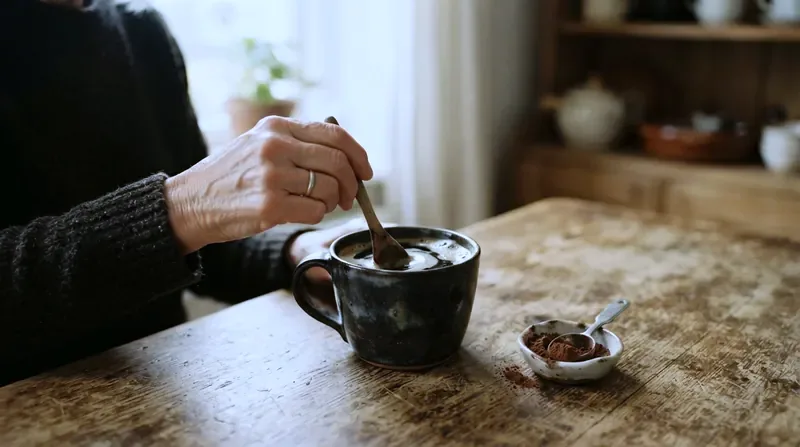
The morning coffee, the classic: one scoop, 8 grams, stirred fifteen seconds into a mug of drip coffee.
The club's unanimous baseline.
The pour darkens, a foam rises, the chocolate sits under the coffee instead of fighting it. Ruth has now made this 60 mornings in a row, which is the strongest data point this column owns.
Almond milk, hot: the seller's own first suggestion.
Patsy's report: "Closer to actual hot chocolate than anything I've made at home.
The almond milk is sweeter than the pouch, so they meet in the middle."
The afternoon smoothie: half a scoop in a blender with a banana and milk.
June's report: "The banana does the sweetening the pouch refuses to do.
This is the version for people, and I mean me, who wanted it sweeter."
Plain hot water: tried once, for science.
Patsy's verdict stands as printed earlier: drinkable, barely, and not the reason anyone buys this.
Dark chocolate with no sugar and no milk is exactly what it sounds like.
Baking, Dolores's experiment: two scoops folded into a plain yogurt-cream dessert.
"It turned something boring into something company-worthy.
I'm no longer reviewing the supplement. I'm hoarding it."
The pattern across five preparations: the pouch behaves like cocoa powder with better manners. It dissolves, foams, and carries its turmeric note politely.
What it doesn't do is become sweet, because — as the label says in its own quiet way — there's less than a gram of sugar in it, and no amount of whisking changes that.
For readers who want the sweet version: the recipe is a spoonful of honey or a banana, and honesty about which ingredient is doing the work.

The Tuesday It Went Around the Table
The column returns to the book club kitchen once a month, because a page that reports only the first taste of anything is a postcard, not a magazine.
By late March, the pouch had been in four households for four weeks. The roll call:
Ruth: one scoop in the morning coffee, daily, sixty mornings and counting.
"The routine runs itself.
I don't think about it, which in my experience is how the good habits work."
Dolores: ordered her own pouch in week two, "for the recipes," and was seen drinking the morning version at her own kitchen table when the columnist arrived unannounced.
When asked, she said, "I'm reviewing it still," which the club accepted without comment.
Patsy: half a scoop in the afternoon smoothie, the sweetened version.
"The sweet tooth gets a chocolate smoothie and I get to feel smug about the label.
Everyone wins."
June, this columnist: maintains the disguise of neutrality, while noting for the record that a pouch appeared in this columnist's own pantry in week three, purchased with the magazine's debit card.
Journalism has limits, and this column reached them in week three.
The club also ran the only experiment it could agree on: the blind taste test. The same coffee, two mugs, one with the scoop and one without, prepared by Ruth while everyone else faced the window.
Four out of four identified the cacao mug on the first sip. "You'd have to be dead from the nose up to miss it," Dolores ruled, and the experiment was closed for lack of suspense.
What the Pouch Is Not
The Corrections shelf, dusted off for this issue, because no column of ours is complete without it.
The pouch isn't brain food, whatever the front panel's "supports mental focus" wants you to hear. No trial has tested this blend on thinking, memory, or anything else, and the seller's own asterisk says so in the government's words.
The pouch isn't a weight plan. The listing's "reduces cravings" carries the same asterisk, and no study of this product exists.
MCT powder in a coffee is a fat in a coffee.
The pouch isn't a caffeine substitute or a caffeine answer. Raw cacao carries small amounts of caffeine and a cousin called theobromine, enough to notice in principle and not enough to plan a day around.
Anyone sensitive to the stuff in coffee should count the cup it lands in.
The pouch isn't medicine and doesn't replace anything a clinician prescribes. If your table has a daily schedule of anything on it, the pouch goes to the appointment too, in the bag, label out.
That sentence runs in every column we print.
And the pouch isn't for every taste, which three-star reviews and Patsy's honey spoon both establish. Gretchen sent hers back within the sixty days, which is the guarantee working, not the product failing.
Ruth's closing note on the file: "A good pouch makes no promises. This one mostly doesn't.
Where it does, it prints an asterisk, and that's the deal."
The Caffeine Arithmetic
One honest question arrived by mail more than once: how much caffeine is in a scoop?
The pouch doesn't print a caffeine line, and the listing doesn't give a number. What the label does give is the ingredient order, and the honest arithmetic runs like this.
Raw cacao carries caffeine and theobromine in small, natural amounts — a fraction, by weight, of what coffee beans carry. The blend is 7.88 grams across eleven ingredients; the cacao is the largest share but not the whole of it, and the whole of it's two and a half teaspoons of powder.
The column can't print a milligram figure that the seller doesn't print, and we won't invent one. What we can print is the comparison that matters at the kitchen table: a scoop of this in your coffee adds the caffeine of the cacao to the caffeine of the coffee, and the coffee was always the bigger number by far.
Anyone who drinks decaf for a reason should ask their own clinician about the cacao, and anyone who drinks regular coffee has already swallowed a larger number before the scoop goes in.
Dolores, who drinks half-caff, tested it for a week and reported: "No difference I can find. But I'm the wrong woman for the experiment — I've been drinking coffee since the Ford administration."
The honest summary, in Ruth's hand: "It's chocolate, not espresso. If the caffeine in chocolate were a problem, the problem would have found you decades ago."
A Field Guide to Chocolate Powders
Because the shelf has more pouches than ever, and because Ruth grades on method, the club offers its portable guide: five checks for any chocolate powder, this brand or any other.
Check one, the sugar line. Turn the pouch around before you fall in love with the front.
Under one gram of added sugar, like this one, means dark chocolate behavior and a recipe you control.
Ten grams means dessert wearing a supplement badge.
Check two, the ingredient order. The first line is the biggest part of the blend.
If the first line is cacao or cocoa, you're buying chocolate.
If the first line is a sweetener or a filler, you're buying a milkshake mix with a cocoa accent.
Check three, the milligram column. Blends print totals, not breakdowns.
That's legal, and it means you can't verify dose claims from the label.
An honest brand leaves it at that; a loud brand prints a percentage on the front and dares you to look for the arithmetic.
Check four, the maker. A street address, a phone number, a named founder, a printed return policy.
All four are on this listing.
The internet is full of pouches with no last name; the good ones sign their work.
Check five, the asterisk. Find it before you buy.
An asterisk is the seller admitting, in small print, that the government hasn't evaluated the sentence it hangs from.
A pouch without any asterisks isn't making fewer claims; it's being less honest about the ones it makes.
Five checks, one minute, any pouch in the store or the feed. Ruth's rule, and now the column's: the label that survives being read aloud earns the shelf.
The Mailbag
The Focused Reader's mailbox, as always, gets a page, and this month's letters run toward chocolate.
From a reader in Ohio, 66: "I bought it for the label and stayed for the taste.
My husband keeps asking why the coffee tastes like a candy shop.
I have told him it's a superfood pouch and he pretends to believe me." The column congratulates the household on its diplomacy.
From a retired mail carrier, 71: "Two dollars and thirty-three cents is what I pay for a lottery ticket I never win.
This morning I won chocolate.
You do the math." We did. It checks out.
From a reader in Oregon, 59: "I wanted to love it and I only liked it.
The bitterness needs the honey, and once I added the honey I felt silly spending the money." Filed beside Gretchen's three stars: honest, and the reason the guarantee is sixty days long.
From a book club in Texas: "We did your blind taste test with three mugs and no window to face.
It was chaos.
The cacao still won." The column thanks the club for replicating the experiment and improving on the protocol.
From Ruth's granddaughter, 29, by text: "Grandma keeps sending me photos of her coffee foam.
Is this a hobby now?" The column can confirm: it's a hobby now.
The Sunday Routine, Filed for the Record
For readers who ask what a month with the pouch actually looks like, Ruth kept the log the way she kept attendance: daily, in pencil, without mercy.
Week one: one scoop in morning coffee, seven mornings.
Two of seven noted as "very good," five as "good." The honey spoon appears twice in the margin.
Week two: the almond-milk version on the weekend, coffee version weekdays.
The honey spoon appears once.
"The taste is growing on me," the log reads, "or I am growing toward it."
Week three: the pouch travels to a weekend at her sister's, survives the trip in a sock in the carry-on, converts the sister.
The log notes: "One pouch, two households, temporary custody dispute."
Week four: the log's summary line, written like a report card: "Habit holds.
Taste settled at 'good, sometimes very good.' Reorder: yes.
The coffee alone is no longer the whole morning."
The column notes what the log doesn't say, which is more interesting: no entry claims anything about thinking, energy, or anything the front panel asterisks. Ruth tracked taste and habit, because taste and habit are what a kitchen log can honestly measure.
Four weeks, 28 scoops, one pouch, about 27 cents of coffee underneath it. That's the whole experiment, and the file is closed.
Letters We Almost Printed
Every mailbox has a second drawer, and honesty lives in it.
The one about the discount. A reader asked whether the "regular price $79.99, now $69.95" on the listing is a real sale.
We don't know.
Two prices on one page is a marketing custom; we print the lower one and the higher one and let the calendar decide. Nothing about the pouch changes between them.
The one about the subscription. The listing offers a subscribe-and-save version at a lower price per pouch.
The column hasn't tested cancellation, and we print what we haven't tested as: untested.
The 60-day refund terms, per the seller's own page, apply to orders within 60 days of purchase.
The one about the scoop. Several reviewers mention the pouch not including a measuring scoop, or including one that varies.
The honest serving is the label's own: 2.5 teaspoons, 8 grams.
A kitchen teaspoon and a half is all the equipment a morning needs.
The one about the blue bowl on the front. A reader asked whether the pouch's photo of cacao in a blue bowl is what's inside.
It's a photograph of the raw material, not the blend.
The blend is a powder, uniform and dark, as the club's bowl can testify.
The second drawer closes. On to the closing credits.
A Short History of the Cacao Cup
Because a column about a cacao pouch owes the bean its biography, and because Ruth's book club takes its history with sugar — or in this case, without.
Cacao was a beverage for a thousand years before anyone thought to eat it. The Maya and later the Aztec drank it ground, unsweetened, often cold, often spiced — a bitter, serious cup that the Aztec called, in their own language, literally "bitter water."
The bean was money before it was dessert. In the markets of the Aztec empire, cacao seeds bought vegetables and cloth, and counterfeiters filled empty shells with clay.
Ruth's note: "the first candy bar was also the first counterfeit. No further comment."
The Spanish carried it across the ocean in the 1500s, Europe added the sugar, and the bitter ceremonial cup slowly became the sweet breakfast of the continent's parlors. The chocolate house of the 1600s was a coffee house with better curtains.
Then came the industrial century, which pressed the fat out of the bean and left cocoa powder behind — cheap, shelf-stable, and missing most of the bean's original fat and much of its character. That's the baking aisle most of us grew up with.
The pouch on Ruth's table is, in the long view, a return ticket: cacao ground without that harsh processing, spiced like the old cup — turmeric, cinnamon, pepper — and drunk hot, in the morning, the way it started.
Dolores's summary, after the history reading: "So we've spent five hundred years adding sugar to it, and this pouch is the first one to take it back out. The pendulum finally swung toward my dentist."
The column prints the history without the mysticism the word "ceremonial" invites. The old cup was bitter and it was serious and, by most accounts, it was loved.
This one is bitter, it's serious, and 3,499 people seem to love it too. That's the whole circle, closed.
The Pouch, in One Last Look
Cacao Bliss, from Earth Echo Foods — a raw cacao drink mix, ceremonial-grade Peruvian cacao first in an 11-line, 7.88-gram proprietary blend with turmeric, MCT powder, cinnamon, black pepper, monk fruit, lucuma and mesquite.
A pouch holds 30 servings of 8 grams; each serving is 35 calories with less than 1 gram of added sugar.
The seller is Earth Echo Foods, LLC of Boulder, Colorado — a street address, a phone number, a founder with a name and a story, and a 60-day refund policy printed on the same site.
The front panel makes three asterisked claims about focus, energy and cravings; the column doesn't repeat them, the label's own small print explains why, and the honest sentence about this pouch and anyone's brain is the one that ends with the asterisk.
The taste, by four testers and one blind taste test, is dark, rich and barely sweet — chocolate for grown-ups, in the words of the host, needing honey in the words of the sweet tooth, and hoarded for desserts in the words of the skeptic.
The price is $69.95 a pouch, $2.33 a morning, with bundles lower. The guarantee is sixty days.
The reviews number 3,499 at 4.8 stars, and the column read the wall including its three-star days.
The Focused Reader's honest summary
The seller's own page prints the label, the ingredient list and the terms: 60-day money back guarantee, refunds for orders within 60 days of purchase, support at [email protected] and 888-997-3851. The listing carried its own free-shipping flag on the day we read it; the store's standing notice says free shipping on orders over $100. The same terms we read before the first scoop landed in the first mug.
The label, line by line — what ceremonial-grade cacao is, what the 11-line blend does and does not print, why the pepper is in there, and what the cited research does and does not say about any of it — is written out in the ingredient and advertising guide linked at the foot of this page.
The guide also covers the caffeine arithmetic, the questions worth taking to your pharmacist, and which of our advertising headlines deserve your skepticism.
Ruth's advice, for anyone on the fence: buy one pouch, not three. A month of mornings is a fair test, and the bundle can wait.
Thirty scoops at one a day puts the last spoonful on day thirty. That leaves a month to judge it, with time to spare inside the sixty days.
Dolores, the skeptic, adds one more line. Write the date the pouch arrives on the back of it, so the sixty days don't sneak past you.
If the taste isn't for you, that's what the sixty days are for. One email to the seller's support address starts the refund.
30 servings per pouch · 60-day money-back guarantee · A real phone number on the seller's page
The Focused Reader · Kitchen Radio, Segment 1
Ruth and Dolores Argue About the Chocolate
The magazine wanted a conversation about the pouch. I told them the kitchen gives three minutes and no retakes. Dolores, the floor is yours.
Thirty-one years she took attendance, and now she takes it on her own mornings. The scoop is in the mug by 7:15. I've seen it. I have photographs.
You ordered your own pouch in week two, Dolores. The club has photographs of that too.
For the recipes. I maintain the recipes are a separate question from the review, and I'll die on that hill with a dessert in each hand.
She made a yogurt thing with two scoops in it that silenced the whole table for a full minute. That's the review, as far as I'm concerned. Silence is the top of the rubric.
The honest part? I checked the label like she taught us, sugar first. Under a gram. That's the only reason I let it in the house. My sister's pantry is a museum of candy masquerading as vitamins.
And the honest part from me: I like the ritual more than I expected. The whisking, the foam, the two minutes. Thirty-one years of other people's mornings, and it turns out I never built one of my own with any care.
Write that down. Not the chocolate part — the two minutes part. The chocolate is just the excuse, same as the crossword and the phone calls. We're old enough to say that out loud.
The magazine is writing it down. And with that, the kitchen adjourns until the next pouch or the next scandal, whichever the mail brings first.
$69.95 a pouch when we checked · About $2.33 a morning · Price set by the seller
The Granddaughter's Question
Ruth's granddaughter, the one texting about foam photographs, visited in April and put the question the young always put: "Grandma. Is this a wellness thing or a chocolate thing?"
Ruth thought about it over the second cup, which tells you something about the question.
"It's a chocolate thing that dresses like a wellness thing," she said finally. "The cacao is real, the label is short, and the sugar is missing.
If you want wellness, walk the block. If you want chocolate that behaves, stir the scoop."
The granddaughter texted the answer to a group chat of her own, and the following week a pouch arrived at a college apartment in the city, ordered by a 29-year-old with her own money.
The column notes the circulation, because circulation is the only metric a kitchen column keeps: one gift pouch in February, four households by March, one college apartment by April.
Two generations, one pouch, opposite reasons. The column has run long enough to know that this is how the good products arrive in a family — not by promise, but by the spoon.

The Second Segment, Recorded Later
The Focused Reader · Kitchen Radio, Segment 2
Patsy Reads the Reviews Out Loud
Ruth, I did the homework. Three thousand four hundred and ninety-nine reviews, and I read the ones that matter. The ones about taste. Sit down.
I'm sitting. I have been sitting since 1962, when necessary. Read.
Deanna, five stars: "Makes my coffee taste better!" Which is the whole thing in six words, Ruth. Six. I couldn't do it in six.
Six words and a shovel would improve most advertising. Continue.
And then Gretchen, three stars: didn't care for the taste, needed other things added for flavor. I want it noted that Gretchen and I would be friends. The honey spoon exists for a reason.
Noted, and entered into the record. The wall keeps its bad days, which is why I read it. A wall of nothing but stars is a poster, and this one has a spine.
E., five stars, says "delicious, rich flavor, and not too sweet." Which is the review I'd write if I were braver. I add the honey. E. is braver.
The honey is honest, Patsy. The label says under a gram of sugar, and you're a woman who reads labels and then answers them. There's no shame in the margin notes.
That's the kindest thing anyone's said about my pantry. Final word?
Three thousand people can't all be wrong about taste, and one three-star woman makes them believable. Read the wall, then pour your own cup. That's the whole method, and it's free.
Earth Echo Foods, LLC · Boulder, CO · Questions first? 888-997-3851
Questions the Kitchen Keeps Asking
What readers asked this month
Is Cacao Bliss a coffee or a cocoa?
Neither, exactly. It's a powder you stir into a drink you already make — coffee, milk, almond milk, water, a smoothie. Alone in hot water it tastes like dark unsweetened chocolate.
How much caffeine is in a scoop?
The label prints no caffeine line, and we won't invent a number. Raw cacao carries small amounts of caffeine and theobromine; the coffee it lands in is the bigger number by far.
Is it sweet?
Barely. Under 1 gram of added sugar per 8-gram scoop, per the label. If you want sweet, the recipe is a spoonful of honey or a banana — and honesty about which ingredient is doing the work.
What does "ceremonial grade" mean?
It's the cacao trade's term for the highest-quality drinking cacao, minimally processed, here from a single farm in Peru. It isn't a government grade, and it's a compliment to the bean, not a claim about your brain.
Why doesn't the label say how much cacao is in it?
The 11 ingredients are a proprietary blend: the total, 7.88 grams, is printed; the breakdown isn't. Ingredient order runs by weight, so cacao is the biggest share — but no milligrams are printed for any line.
Can I cook with it?
Yes — the seller links recipes, and our skeptic folded two scoops into a yogurt dessert with what she called "company-worthy" results. It behaves like cocoa powder with better manners.
What if I don't like the taste?
The seller's page prints a 60-day money back guarantee, refunds for orders within 60 days of purchase, through the support email. One of this month's letters did exactly that.
Should I ask my doctor first?
If your table has a daily schedule of anything on it — and at our readers' age, most tables do — the pouch goes to the appointment too, in the bag, label out. That sentence runs in every column we print.
How to Read a Blend Label, in Four Steps
The pouch taught the club something this month, and it wasn't about chocolate. It was about the panel itself — the little table on the back of every blend, pouch, and tub on every shelf in America.
Ruth, who spent three decades teaching children to read the hard parts first, offers the method as four steps. The column prints it as a service, and it works on any blend in the store.
Step one: find the serving size. Everything on the panel is per serving, and the serving is chosen by the seller.
An 8-gram scoop and a 4-gram scoop are different products with the same front panel.
This pouch prints 8 grams, 2.5 teaspoons, and the column respects it for being an honest, kitchen-scale number.
Step two: count the lines before the blend. The nutrition lines above the proprietary blend — calories, fat, sugar, fiber — are the only measured facts on the panel.
This one: 35 calories, 1.5 grams of fat, 2 grams of fiber, under 1 gram of sugar.
Four lines, four facts you can bank.
Step three: read the blend by order, not by hope. Proprietary blend means the total is printed and the parts aren't.
The order is by weight, descending.
First line, biggest share. The front of this pouch says cacao; the first line of the blend is cacao; the panel agrees with the label, which is more than some pouches can say.
Step four: find the asterisk and read what it hangs from. The asterisk means the government hasn't evaluated the sentence it marks.
It's the most honest character on the whole package, and it lives on this pouch's front panel, right where the claims are.
Four steps, ninety seconds, any blend in the pantry. The club's consensus, filed under things we wish we'd learned forty years ago: the panel is a map, and most people have been reading only the cover.
The Verdict Table, Set for Company
The book club's final meeting on the pouch was held, by tradition, over dessert, with the verdicts read aloud and entered into the record.
What the club can say for the pouch, after a month:
The label is short and legible — eleven ingredients, all of them foods, ten of them certified organic, and the eleventh is salt.
The sugar is under a gram, honestly printed, with the sweetening done by coconut nectar and monk fruit instead of a chemistry lesson.
The taste is dark, rich and barely sweet, exactly as the five-star and three-star reviewers both describe.
It mixes into coffee in fifteen seconds with a foam, and into desserts with what the skeptic called "company-worthy" results.
The seller signs its work: a street address in Boulder, a phone number, a named founder, a 60-day refund policy.
And what the club can't say for the pouch, in the same breath, because the club keeps its breath honest:
No trial has tested this blend on thinking, energy, or anything else the front panel asterisks.
The blend prints no milligrams, so no dose claim on the listing can be checked from the label — not the pepper's 2,000 percent, not the salt's 84 minerals.
The taste isn't for everyone, and the price isn't for every Tuesday, and both of those are verdicts, not flaws.
Ruth entered the final line of the season's file in pencil, and the column prints it as received: "The pouch is honest chocolate from a company that answers the phone. What it does beyond taste is the asterisk's business, and the asterisk works for the government."
8.34 oz pouch · 30 scoops of 8 grams · 60-day money-back guarantee
The Closing Credits
Every column in this magazine ends the same way: the sources, the standards, and the door.
The sources. The label and its panel, transcribed.
The seller's listing, read on the day we cite it.
The review wall, including its three-star shelf. The research file on cacao flavanols, turmeric, and the ginkgo lesson, cited below with its numbers.
Nothing in this column came from anywhere else, and the composites are declared as composites.
The standards. We don't print the front panel's three claims as findings, because they aren't findings, and the asterisk agrees.
We don't repeat a seller's percentage — the pepper's "2,000 percent," the salt's "84 minerals" — without saying whose number it is.
We quote reviewers in their own words, including the ones who didn't like it. We tell you what we bought and when.
The door. Ruth stirs her scoop at 7:15.
Dolores hoards hers for desserts.
Patsy adds the honey and answers to no one. The granddaughter has a pouch in a college apartment, opposite reasons, same spoon.
If your mornings have gone thin at the edges — if the coffee was never really yours to savor — the column's only advice is the advice we print on every page like this one: read the label yourself, ask your own clinician what belongs at your table, and keep the receipt.
Whether the pouch passes your reading is a conversation between you, your kitchen, and your own sweet tooth. Ours voted four to nothing, with one honey spoon abstaining.
The Focused Reader returns Thursday, with a column about a pocket radio and the man who fixed the whole county's in 1987. Keep the kettle warm and the crossword in ink.
P.S. If you made it this far, you're the reader this magazine was built for, and the coffee is on me at the spring potluck — the chocolate kind if you're Ruth, the café kind if you're Dolores, and both if you're the neighbor who borrows the good scissors.
P.P.S. The doctor's appointment beats the pouch, every time, no exceptions at this table and none at yours — which is the entire point of having a table.